Marine Cargo Claim Assessment: What the Policy and Evidence Must Support
Twenty cartons arrive wet. The invoice gives you a value. Neither tells you what the insurer owes.
A marine cargo claim assessment connects the policy, the shipment history, the evidence of damage, and a supported loss calculation. Coverage analysis asks whether the loss falls within the actual insurance contract. Valuation asks how much loss the evidence supports. A sound assessment keeps those questions separate until there is enough evidence to connect them.
This guide is for US cargo claims professionals, adjusters, and marine surveyors. It concerns cargo, not hull or P&I claims. The worked calculation is fictional and educational, not a customer claim or output from FieldScribe AI. A separate redacted report sample is linked below. Policy wording, applicable law, and the insurer's instructions govern the real assessment.
Start with three questions, not a settlement figure
- What was insured? Identify the policy, certificate, endorsements, insured interest, goods, voyage, and relevant dates. Record the exact wording you rely on, including valuation terms, limits, deductibles, conditions, and exclusions.
- What happened to the cargo? Separate observed damage from reported events and unresolved cause. Connect quantities and condition to identifiable packages, receiving records, and photographs.
- What loss can you support? Explain the selected valuation basis and each quantity, rate, repair cost, and salvage adjustment. Do not turn an unsupported assumption into a payable amount.
For example, Chubb's US marine claim reporting form asks for shipment value, deductible, voyage, bill of lading details, damage description, and estimated damage. These are useful intake fields, not a promise of coverage or a complete assessment.
Build an evidence file that answers specific questions
- Policy and endorsements: which version applies, which transit is insured, and which terms affect this loss?
- Invoice and packing list: what goods and quantities were shipped, and what supports their value?
- Bill of lading and delivery receipt: which shipment arrived, when, under what recorded condition, and with which seal?
- Receiving tally and package-linked photos: how many units are affected, and does the damage concern packaging, contents, or both?
- Inspection findings, tests, and repair quotes: what supports the cause assessment and proposed treatment? Use temperature records or contamination testing where relevant.
- Salvage, mitigation, and disposal records: what value remains, what action was authorized, and what costs or proceeds are documented?
ONE's North American cargo-claims guidelines call for an itemized claim, transport and commercial documents, receiving records, photographs, and relevant salvage evidence. That is a shipping carrier's claim procedure, not the cargo insurance policy. Confirm notification and time-limit requirements promptly with the relevant parties rather than assuming every claim follows the same rules.
Worked example: 20 wet cartons, three different conclusions
Fictional scenario: a US consignee receives 100 cartons of manufactured components. The invoice lists $200 per carton. A receiving tally identifies 20 wet cartons. In this example, inspection records support eight cartons with unusable contents; the other 12 contain serviceable goods that need replacement packaging. A documented quote is $25 per carton for that work.
Observation: 20 cartons were wet. Extent: the records support eight unusable cartons and 12 requiring repacking. Cause and coverage: still under review. A wet carton alone does not establish seawater ingress, the point at which wetting occurred, or an insured cause.
A provisional calculation, not a payment recommendation
- Invoice reference for unusable contents: 8 cartons × $200 = $1,600.
- Quoted repacking: 12 cartons × $25 = $300.
- Working cost subtotal: $1,600 + $300 = $1,900.
The $1,900 is an illustrative worksheet subtotal. It is not an insured value, agreed assessment, or payable claim. The invoice basis and proposed repacking must still be tested against the applicable policy and the evidence. Salvage is unresolved, not silently treated as zero. Policy valuation, any eligible additional costs, limits, and deductible treatment also remain to be assessed.
Do not value all 20 cartons as a total loss and then add the repacking of 12 of those same cartons. That would count mutually inconsistent treatments. Likewise, a repair quote is not proof that the work was completed or that the insurer accepts the cost.
Write the unresolved issue precisely
Receiving records identify 20 wet cartons. Inspection records support eight cartons with unusable contents and 12 requiring repacking. The provisional cost worksheet totals $1,900 before unresolved valuation, salvage, and policy adjustments. The timing and mechanism of wetting remain unconfirmed; no final coverage or payment conclusion is made.
That paragraph gives the next reviewer a clear task. Obtain the missing transit and condition evidence, check the relevant policy wording, and resolve valuation and salvage before recommending a final amount.
Where the Assessment Engine helps
FieldScribe AI's Assessment Engine uses policies and supporting evidence to perform coverage analysis and prepare an assessment for the adjuster or surveyor. It is more than report formatting. The professional reviews the analysis and assessment before sign-off; it does not replace insurer approval.
The worked example above explains assessment logic. It is not a demonstration of the engine's output, an accuracy benchmark, or evidence that the product catches every error. When reviewing an AI-assisted assessment, ask:
- Does each important conclusion have support in the supplied policy and claim evidence?
- Are missing facts identified as missing rather than supplied by assumption?
- Do the quantities, valuation basis, costs, and adjustments reconcile?
- Is the distinction between a provisional assessment and an approved payment clear?
Use the workflow on your next review: download the blank assessment review worksheet. Add document references and open questions before making recommendations. It is an editorial review aid, not an exported product template.
See the populated report, tables, and actual assessment
The calculation above is fictional. This 20-page redacted report sample uses original pages from an Indian inland-transit assessment in a company’s own format. The populated fields, tables, quantities, dates and financial workings remain intact. Names, identifiers, exact locations, branding and signatures are masked. Extended annexure material is omitted from this abridged version—not rewritten.
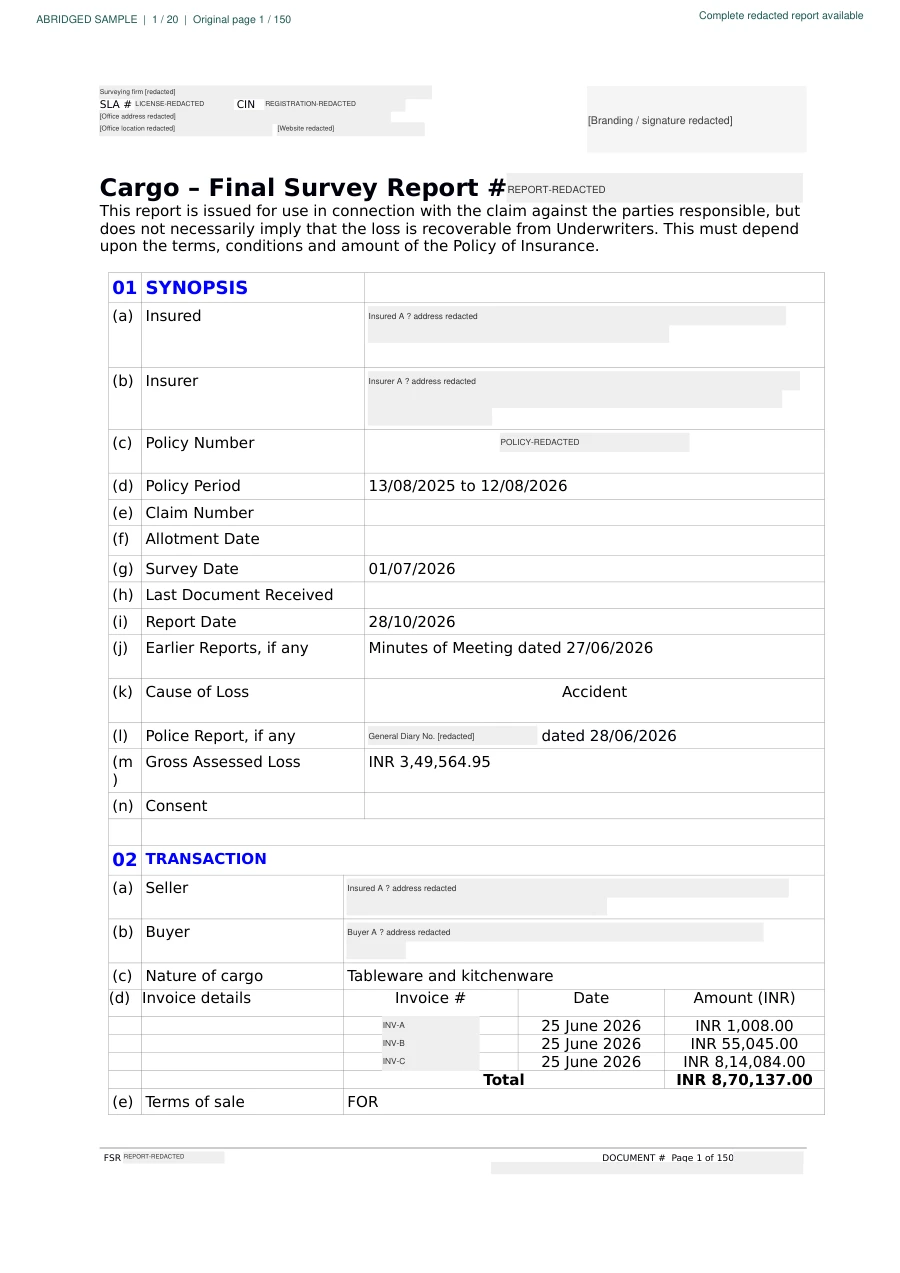
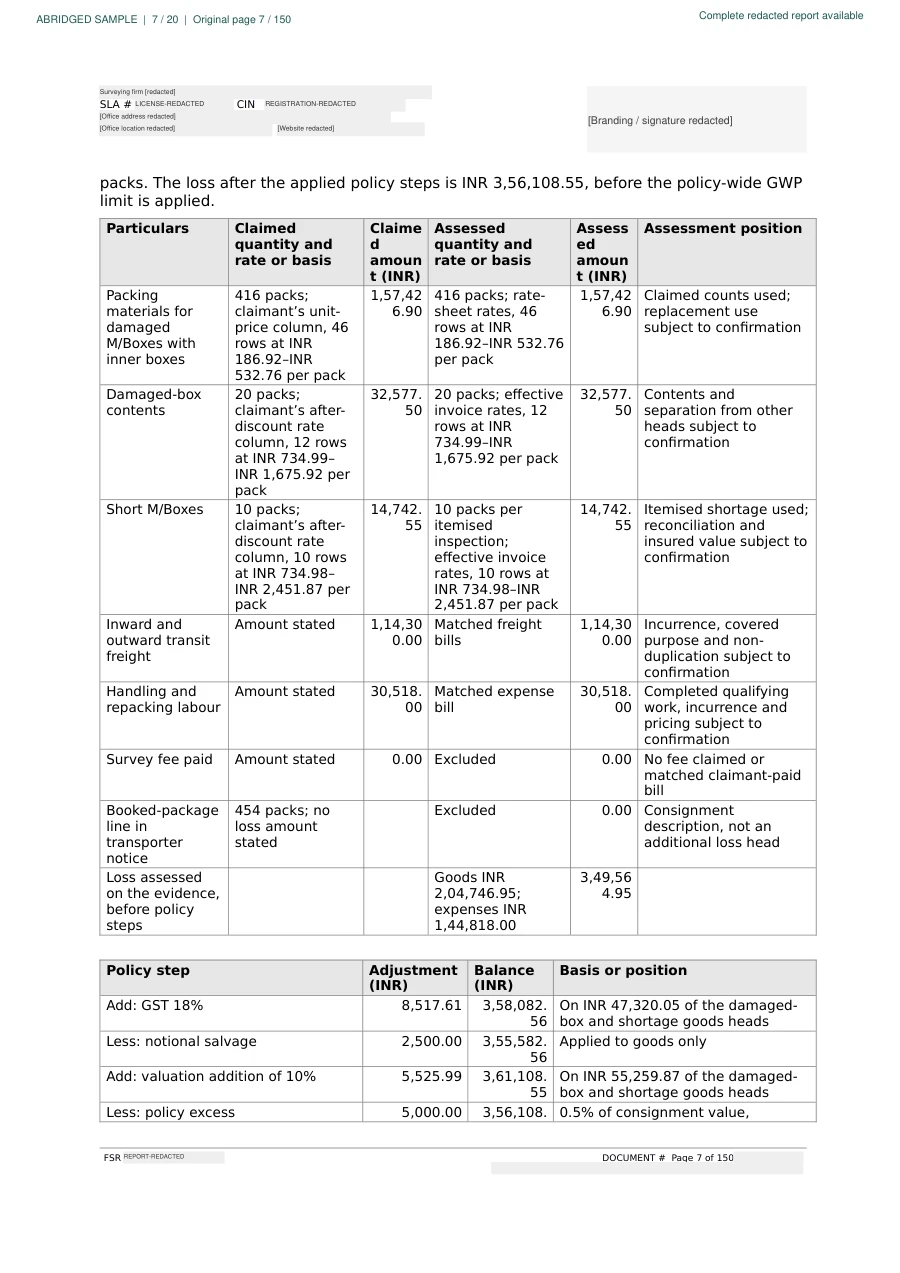
- Inspect the format: the synopsis, shipment particulars, supporting records and invoice details remain in their original sections and table cells—not a new generic narrative.
- Follow the assessment: compare packing, damaged contents, shortage, freight and labour before reviewing tax, salvage, valuation and excess adjustments.
- Review the reasoning: the assessment overview starts on page 13, followed by selected policy analysis. Evidence conflicts and closing qualifications remain visible.
For the complete annexure and all 28 tables, download the full 150-page redacted PDF or editable Word report. This is not a US coverage precedent or an approved settlement: unresolved coverage questions, the policy-wide limit and source-summary inconsistencies remain for professional review.
Keep insurance coverage and carrier recovery separate
A cargo insurance assessment and a claim against the transport carrier address different obligations. ONE expressly states that acknowledging a claim is not an admission of liability. Do not treat carrier acknowledgment as acceptance of insurance coverage, or an insurance calculation as proof of carrier liability.
For report structure, use our marine survey report guide. For records across transit and storage, see the transit and warehouse documentation guide. This article focuses on the reasoning that belongs inside the assessment.
See how policy and evidence enter the workflow
Follow the five-step assessment and reporting workflow, or watch the product walkthrough for the available workflow demonstration. To discuss a marine-specific assessment, request a demo. The published walkthrough is not presented here as a marine assessment case study.
Sources checked October 29, 2026: Chubb US Marine Claim Reporting Form and ONE North American Cargo Claims Guidelines, linked above. These sources support the documentation discussion; they do not endorse FieldScribe AI. Educational guidance, not a coverage opinion on a particular loss.
FieldScribe AI editorial team
Practical documentation guides
Source-linked working guides from FieldScribe AI. Examples are illustrative, not customer case studies. These articles are educational and do not replace professional judgement, policy wording or local requirements.
Find more of our reporting in Google Search
If our articles are useful to you, add FieldScribe AI as a preferred source on Google so our content shows up more often when you search.
Related Articles
Wind and Hail Inspection Documentation: A Field Checklist for Adjusters
A storm map and thirty roof close-ups can still leave the reviewer guessing. Connect site observations to their locations and sources without overstating cause.
Insurance Claim Supplement Documentation: Show What Changed and Why
The estimate increased. What changed? Use a line-by-line evidence matrix to distinguish new findings, quantity corrections and open questions.
Insurance Claim Photo Log: Free Template and Caption Examples
The damage is visible. The room is not. Give each claim photograph a location, a finding and a clear link to the report—with a free photo-log CSV.